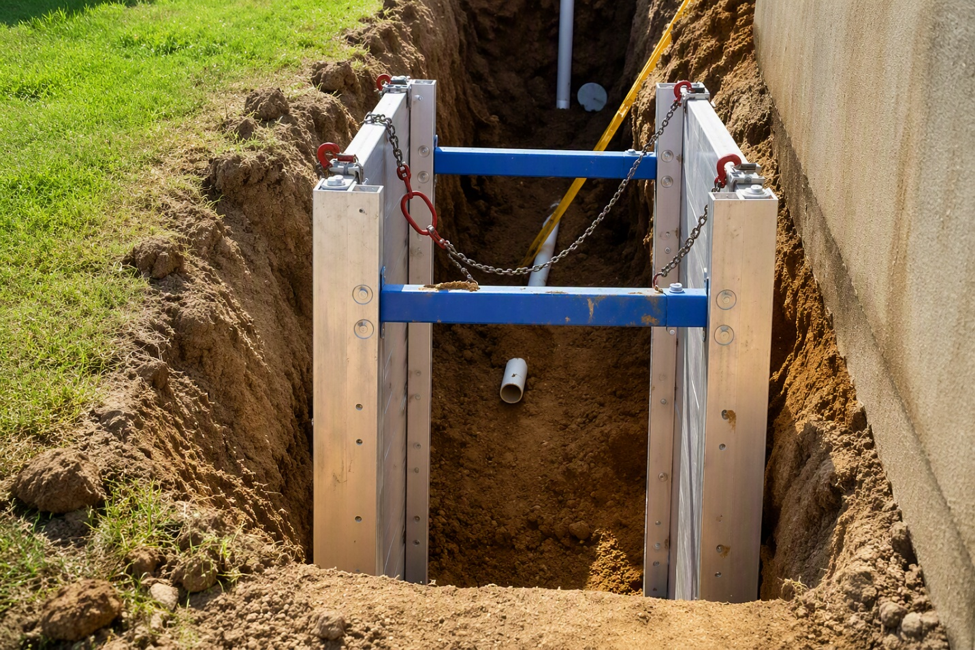
Choosing the Right Trench Protection: When to Use Modular Boxes and Trench Shields

Every excavation is different. Every jobsite brings its own challenges. But one priority remains the same: protecting the people working below ground with practical, reliable trench protection solutions.

The right trench protection system can make a major difference in jobsite safety, excavation efficiency, equipment utilization, and overall productivity.
For contractors working on water and sewer lines, utilities, pipelines, drainage, maintenance, and underground infrastructure, the choice often comes down to two highly practical solutions: modular trench boxes and conventional trench shields.

Both provide effective worker protection when properly selected and installed. The key is choosing the system that works best with your excavation dimensions, soil conditions, equipment, installation sequence, and site constraints.
At ESC Trench Shoring Inc., we supply trench safety systems built around real field requirements, from lightweight modular aluminum boxes to heavy-duty steel trench shields.
What Is a Modular Trench Box?
A modular trench box gives contractors greater flexibility when a standard trench shield is not the most practical fit.

Instead of a fixed configuration, modular systems use interchangeable components that can be assembled to suit different excavation layouts.
ESC Modular Aluminum Trench Boxes can be arranged in two-sided, three-sided, and four-sided configurations, making them particularly useful for utilities, pits, service connections, maintenance work, and restricted-access excavations.
Why choose an ESC Modular Aluminum Trench Box?
A modular system can be a smart choice when your project requires:
Flexible box configurations
Lightweight, manageable components
Quick mobilization between excavation areas
Access around existing utilities
Protection for localized or irregular excavations
Equipment suitable for smaller jobsites
A system adaptable to different project requirements
For contractors managing multiple excavation types, that flexibility can mean less downtime and better utilization of trench safety equipment.
When Does a Conventional Trench Shield Make More Sense?
For long, consistent excavations, a conventional steel or aluminum trench shield can offer a highly efficient solution.
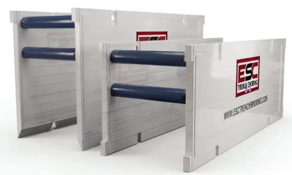
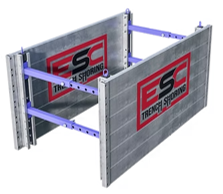
These systems typically consist of two engineered sidewalls connected by spreaders, creating a protected working area for personnel inside the excavation.
Ideal applications include:
Water and sewer pipelines
Large-diameter pipe installation
Stormwater and drainage projects
Utility construction
Long, narrow excavations
Repetitive cut-and-install operations
Deeper excavations requiring appropriately rated shielding
For these projects, contractors can excavate, position the shield, complete the installation, backfill, advance the shield, and continue working down the alignment.
This straightforward workflow can help maintain productivity across longer trench runs.
Modular Trench Box or Conventional Trench Shield?
There is no universal solution for every excavation.
The better system is the one that fits the actual conditions on your jobsite.
Project Requirement | Modular Trench Box | Conventional Trench Shield |
Changing excavation layouts | Excellent | Good |
Utility connections and tie-ins | Excellent | Good |
Manholes and localized excavation | Excellent | Application dependent |
Long pipeline trenches | Good | Excellent |
Large pipe installation | Application dependent | Excellent |
Restricted-access sites | Excellent | Equipment dependent |
Portability | Excellent | Depends on system |
Configuration flexibility | Excellent | Moderate |
Repetitive trenching | Good | Excellent |

Trench protection selection should be based on project-specific engineering requirements, site conditions, and the manufacturer’s applicable tabulated data.

Start With Your Excavation
Before selecting a trench protection system, look at the basic geometry of the excavation:
How deep is the trench?
What working width is required?
How long is the excavation?
Will dimensions remain consistent?
What pipe or structure is being installed?
Are there existing underground utilities?
A project involving service connections, utility crossings, pits, structures, or changing excavation dimensions may benefit from the greater flexibility of a modular system.
Think About Existing Utilities
Underground utilities can quickly turn a straightforward trench into a complicated excavation.
Existing Think About Existing Utilities water mains, gas lines, electrical services, telecommunications, sewers, and intersecting pipelines can affect where and how a trench protection system can be positioned.
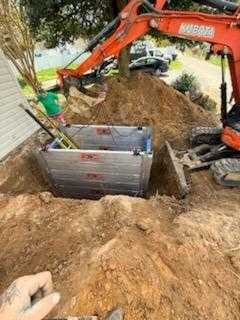
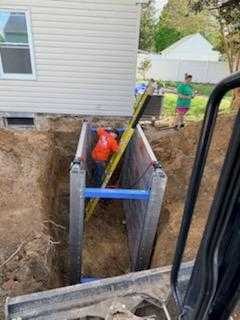
This is where modular systems can offer a significant advantage.
The ability to adapt the configuration around the work area gives contractors more options when dealing with congested underground infrastructure.
Match the Shield to Your Equipment
A trench protection system should work with the equipment already operating on the project.
Aluminum and modular systems can offer advantages when:
Excavator capacity is limited
Access to the site is restricted
Frequent relocation is required
Transportation space matters
Smaller crews are performing the work
Choosing equipment that matches both your excavation and your excavator can help reduce unnecessary handling and improve jobsite efficiency.
Never Overlook Soil Conditions
Soil classification, groundwater, surcharge loads, nearby traffic, adjacent structures, excavation geometry, and other site conditions can all affect protective-system requirements.
Under OSHA excavation requirements, soils may be classified as Stable Rock, Type A, Type B, or Type C.
The selected trench protection system must therefore be appropriate for the actual excavation conditions and used within the limitations of its engineering data
Choose for Productivity, Not Just Protection
Safety comes first, but the right system should also support the way your crew needs to work.
For long utility installations, that workflow may look like:
Excavate → Position Shield → Install Pipe → Backfill → Advance → Repeat
For repair, maintenance, or utility connection work, the priorities may be different. Crews may need greater access around valves, pipes, manholes, or existing infrastructure.
One Supplier. Multiple Trench Protection Solutions.
Different excavations require different solutions. That is why ESC Trench Shoring Inc. offers more than a single trench box configuration.
Our trench protection range includes:
Whether you need a lightweight system for utility work or a heavy-duty trench shield for demanding pipeline construction, ESC can help you identify a solution suited to your project requirements.

Need a Trench Box? Start With Your Project Details.
Choosing the right trench protection system is easier when you start with the right information.
Trench depth • Trench width • Soil classification • Pipe diameter • Project type • Excavator size • Site constraints

Our team can use those project parameters to help determine a suitable trench protection solution.
Protect the excavation. Keep the project moving.
Contact ESC Trench Shoring Inc. today to discuss your project, request a quote, or find the right trench box or trench shield for your jobsite.
Disclaimer:
Information provided by ESC Trench Shoring is intended as general product guidance and does not replace project-specific engineering review. Selection, installation, and use of trench shields, trench boxes, and other protective systems must comply with applicable regulations, site requirements, and the manufacturer’s tabulated data.